There are invitations you circle on the calendar the moment they land, and then there are invitations that make you re-read the sender line twice to make sure it's real. Microsoft Leadership Connection at the Microsoft India campus in Bangalore, with Satya Nadella on the main stage, was firmly in the second category. I flew in the night before, walked into the campus the next morning, and spent the day surrounded by leaders, engineers, and policy folks who are actively shaping how AI reaches the next hundred million users in India.
This post is my attempt to write down what I actually saw, what I learned, and what I took away — before the memory of the day flattens into a LinkedIn post.
Walking into the Microsoft India campus
The Microsoft office in Bangalore is one of those buildings that manages to feel both quintessentially Microsoft and quintessentially Indian at the same time. The lobby I walked into had a jharokha-inspired reception desk in turquoise and orange, hand-painted panels, and hanging lanterns — and behind all of that, the four coloured squares of the Microsoft logo. It is a small thing, but the design choice tells you exactly how this office thinks about its place in the country: global scale, local roots.
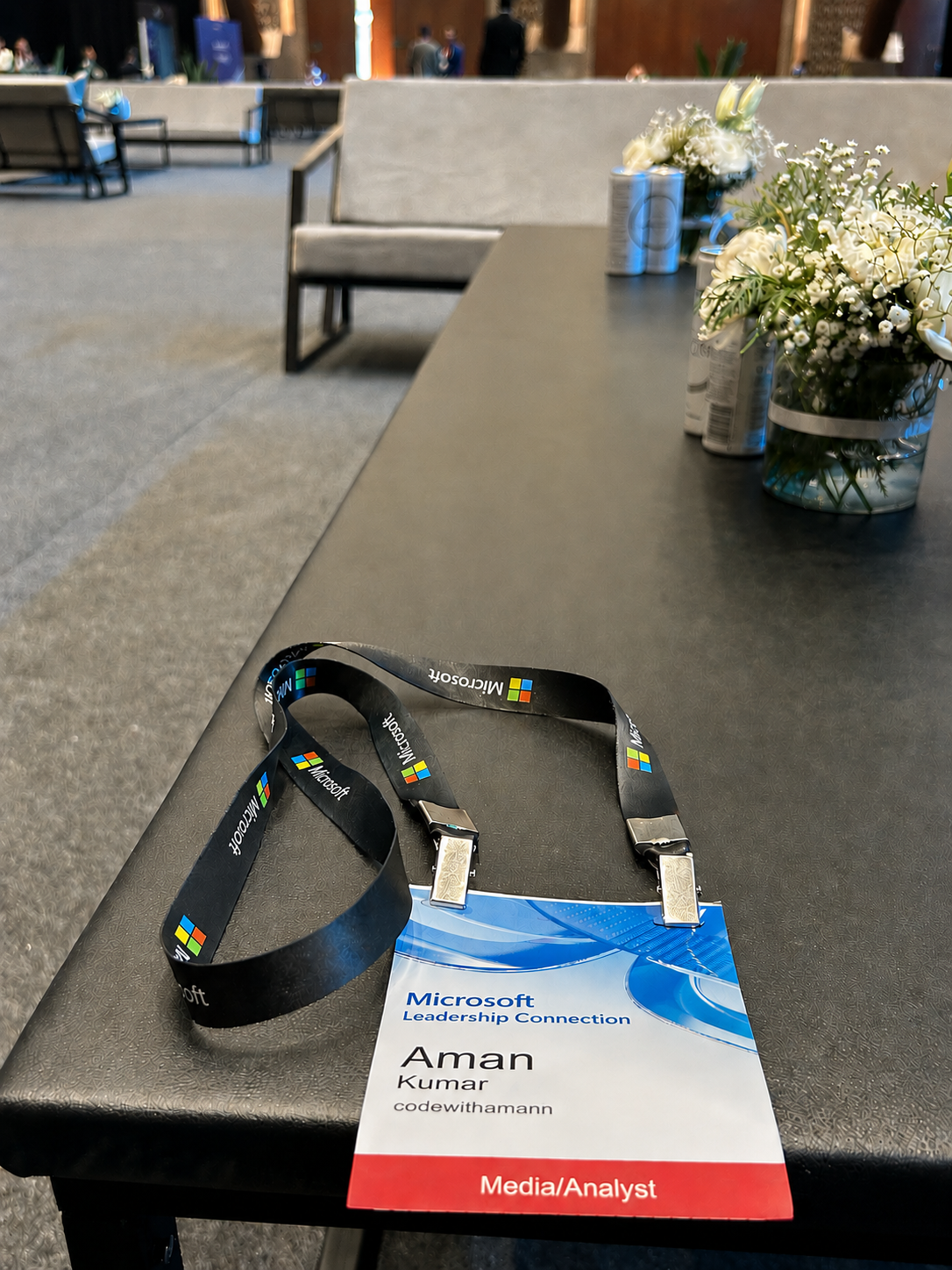
I picked up my badge from the registration desk — Microsoft Leadership Connection, Media / Analyst — clipped it onto a black Microsoft-branded lanyard, and headed into the main hall.
Satya on stage
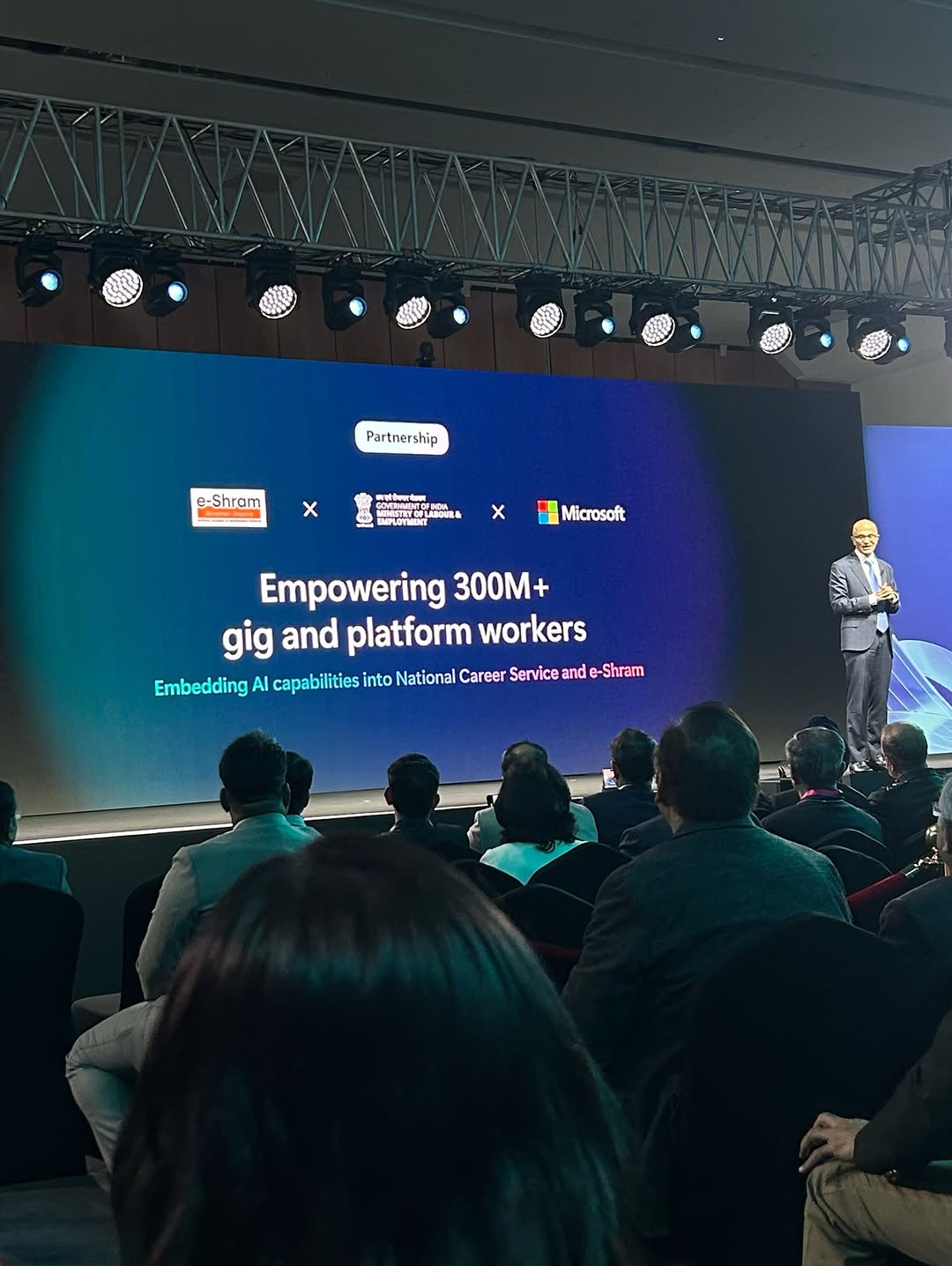
The main session opened with Satya Nadella walking onto stage without much fanfare — no dramatic music, no long introduction — just a short greeting and straight into what he wanted to talk about. If you have watched Microsoft keynotes over the years, you know the rhythm: a hard business point, a customer story, a demo, another hard business point, an anecdote, close. The Bangalore edition of that rhythm was tuned specifically for India.
The single slide that stayed with me for the rest of the day was the partnership announcement between Microsoft, the Government of India's Ministry of Labour and Employment, and e-Shram. The headline read: Empowering 300M+ gig and platform workers — Embedding AI capabilities into National Career Service and e-Shram. Three hundred million is not a marketing number here. It is roughly the size of the informal workforce that this partnership is aiming at. Seeing that number on a Microsoft stage in India, backed by a real government MoU, is different from reading about it in a press release.
The India-specific playbook
What made the keynote land for me was that Satya did not treat India as a downstream market for a US-built product. The framing was closer to: India is where the hard problems get solved first, and the solutions travel outward. A few threads I noted:
- Frontier models are becoming a commodity — the differentiator is the vertical stack sitting on top of them: agents, tools, workflows, and above all, distribution.
- Distribution in India means meeting people where they already are — WhatsApp, government portals like e-Shram, the National Career Service — not asking them to install a new app.
- Small language models fine-tuned for Indian languages, running cheaply on edge and CPU, matter as much as the flagship models running in Azure data centres.
- Copilot is being positioned as an organising layer across Microsoft 365, GitHub, Security, Dynamics, and Azure — not as a single product line.
- Sovereignty and data residency are treated as first-class product features for India, not compliance checkboxes.
The interaction I did not expect
After the main session, there was a curated interaction window for a smaller group in the leadership lounge. I fully expected to spend it in a corner with a coffee, taking notes. Instead, I ended up in a short conversation with Satya himself. It was maybe ninety seconds — long enough to shake hands, tell him what I work on, and ask one question that I had prepared in the taxi on the way in: what should a builder in India optimise for over the next five years?
His answer, paraphrased from my notes so I do not put words in his mouth, was that the biggest lever in the next few years will not be model quality — it will be the developer's ability to compose agents, tools, and data safely across an organisation's context. He was very specific that the winners will be the teams that treat evaluation, safety, and observability as core engineering disciplines, not as an afterthought bolted on before launch. Then he added, with a small smile, that India has never had a shortage of engineers who can build — the question is how quickly we build the muscle to ship responsibly at population scale.
Models are becoming a commodity. The moat is how well you compose them into agents your customers can actually trust.
It is easy to nod along in a moment like that and forget the detail later. I wrote it down on my phone before I left the lounge, and I have been chewing on it since.
What I took away as a builder
A few things crystallised for me that I did not have language for before the summit:
1. Evaluation is the new frontend.
Every serious Microsoft demo of the day showed an evaluation loop — offline evals, online evals, red-teaming, and human review — sitting next to the model itself. Not as a slide at the end, but as a core part of the architecture diagram. If you are building an AI product in 2026 without an evaluation harness, you are shipping a prototype and calling it a product.
2. The interesting agents are boring on the surface.
The most impressive agent demo I saw was, on the surface, a mundane HR workflow — an employee asks for a policy exception, the agent gathers context from three systems, drafts a response, routes it to the right approver, and closes the loop. No fireworks. But watching it stitch across systems reliably, at speed, with an audit trail, is what enterprise AI actually looks like when it works.
3. India-first is a product decision, not a marketing decision.
Building for Bharat means being ruthless about latency, cost per interaction, offline behaviour, language coverage, and integration with existing government and telco rails. If any of those five is treated as a phase-two problem, the product will not scale beyond metro users. The teams inside Microsoft India seem to understand this in a way that some global product orgs still do not.
The hallway conversations
As always at events like this, the sessions are only half the value. The other half is in the hallway. I ended up in three long conversations that were worth the flight on their own — one with a Microsoft PM working on Copilot for public-sector customers, one with a founder building an agentic ops product on Azure OpenAI, and one with a policy researcher from a Delhi think tank who is trying to translate the frontier AI conversation into terms that Indian regulators can actually act on.
The through-line across all three was the same: the technology is moving faster than the institutions around it, and the people who will matter most in the next five years are the ones who can translate between the two.
Leaving the campus
I walked out of the Microsoft campus in the late afternoon light with a lanyard in one hand and a phone full of half-written notes in the other. There is a specific kind of tiredness that comes from a day of high-signal conversation — your brain feels warm, and you know you will keep unpacking it for weeks. This was one of those days.
Huge thanks to the Microsoft India team for the invitation, to the on-ground crew who ran a genuinely well-organised summit, and to Satya for taking the time to talk to a room full of people who are not, yet, running Fortune 500 companies. If the bet Microsoft is making on India-first AI plays out even halfway, a lot of us in this ecosystem are going to have a very interesting decade ahead.
Now I need to go actually build something worth writing about next time.